Last year after much pandemic delay, I took my oldest nephew to Paris; this year, his brother having reached Y7 it was his turn. There’s a third, but that birthday will not be reached by him until 2028! Some of what I know about Paris comes from living there during my year abroad from my French & German degree in 1999; some comes from a few years of winter coach trips with the school I used to work at. A few new things this year came from a friend I trained to teach with who does Paris trips with her own school.
Again I am writing this as much for my own benefit to remember how much we did, because we crammed a great deal in and pounded many miles of pavements (around 50 miles in 4 days!) It was just as EPIC and the nephew was a treasure.
There’s an album of photos on flickr.
Sunday arrival, after dark
Same Ibis hotel as before, 122 rue Lafayette – super close to the Gare du Nord, walkable to Sacré Coeur, Opéra, Grand Rex and on line 7 Poissonière which connects well with lots of lines. There are also many restaurants and cafés in the surrounding streets.
As last year on arrival we dropped bags and started pounding pavements. At least this year we didn’t have to wear masks on the train (everywhere had signs saying masks were compulsory, but only a few people wore them.) We walked down rue Lafayette to the same café I had frogs legs in last year, Restaurant le Royal, 8 rue Lafayette. And I began to realise things had changed over the year and last year as the pandemic was easing we had been extremely lucky to have experienced Paris when it was pretty quiet. This year the café was very busy, the food took ages and we were back to no chattiness from the wait staff, the typical Paris hauteur. Nephew had a burger, I had duck confit with dauphinoise that turned out to be sauté when they arrived. Oh well. We tried frogs legs again, and the nephew made some extremely entertaining disgust faces.
The ultimate goal of the walk was to climb the Arc de Triomphe for night views over the roofs of Paris; last year we got there too late so this year I put us on the metro at Opéra after marvelling the building a bit from the outside. Next time I want a backstage tour of the palais Garnier! (there’s an online one here). This year I used Google Maps to plan lots more of the journeys rather than just eyeballing the metro map, and it favoured the RER a lot over metro trains, so it took us through long walkways to Auber, which is below the Opera tube station and just one stop away from Étoile for the Arc de Triomphe. Which was, of course, closed as we got there. The ticket office closes 45 minutes before the top and without a ticket you can’t get up. So instead we just decided to take pictures of the outside, see the Eiffel Tower for the first time and go on a bit of a wander.
A bit of a wander turned into another 5k on top of the 2k we did from the hotel to the restaurant. We walked from the Arc to the gardens of the Trocadero (it turned out, I didn’t realise at the time and turned away). We turned east and walked along the Seine. We crossed at Pont de l’Alma, stopping for Eiffel Tower pics, walked along to Esplanade des Invalides and crossed pont Alexandre III. Photos, Jeff Koons Balloons, homeless people in tents, and rats. Place de la Concorde, Jardin des Tuileries (well the outside of the garden wall.) We peaked at the pyramid and then got on the métro at Palais Royal and headed home.
This time, btw, I didn’t buy “Paris Visite” metro cards, but a series of carnets (the book of ten singles). I will tot up when the credit card statement comes whether it was cheaper or not. There were starting to be signs that they are phasing out carboard metro tickets, so I don’t know what system will be in place next time I go.
Sunday – 18,759 steps, 27 flights of stairs, 13.6km, 3,996 calories burned
Day 2 – Monday
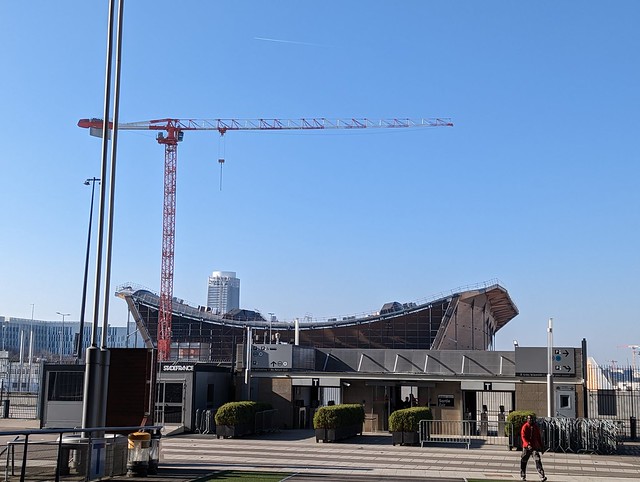
As last time, I had booked a guided tour of the Stade de France. I made the same mistake as last time in that they only have English language public tours on Fridays and Saturdays and we were only there Sunday to Thursday, so I had to translate again. The infrastructure is brilliant, the tour has lots of show biz gossip as well as football facts and this time we weren’t shown the jail, we saw the onsite hospital instead. The cranes building the Olympic pool are still there but there has been a lot of progress:

From the Stade de France back into the city – this time to actually climb the Arc de Triomphe and get the views. Then two visits booked on the internet the night before, with time stretching a bit. We were bang on time for FlyView Paris – a virtual reality experience where you stand on a fake jetpack and wear VR goggles. I booked two experiences – a flyover all of France and one just of Paris (they also offer Hidden Paris and… the Pyramids…) we started with France and it took us on a whistlestop tour of the entire nation, criss-crossing and returning. I mentally polished my nails to find I’d been to about half the sites already in person. The VR thing occasionally gave you control and it let you pick your own path over Etretat in Normanday and the alps at Aiguille du Midi / Chamonix, where you had to fly over mountains and the sea. This was quite awesome… then we came back for a second tour because if you booked 2, the 2nd was at a massive discount. But the version of the VR they used for the Paris tour was a generation before – no private headphones, no choices of where to fly, slightly lesser graphics. This time as I flew over I was noticing that the Paris sites were out of date. Notre Dame was intact, there was no security fencing at the Eiffel Tower and so on. It was still worth doing – you get to see things from a point of view you could never see in real life.
After that, we were already late for our timed Louvre tickets at 4pm – and we also hadn’t had lunch. So we walked to the Louvre, stopped at a Paul bakery and bought jambon-fromage baguettes which turned out to be a taste sensation for the nephew who ended up having 2 more over the next three days! We walked and ate and I was conscious literally no-one else in Paris would dream of walking and eating when you could sit down and enjoy it properly.
The Louvre let us in, just about, the queue for ticketed entry at the Pyramid wasn’t tooooooo bad. (Last year I went in through the Carousel, much easier, and of course there is also the Port de Lions entry on the other side with no queue) The place was absolutely rammed and we allowed ourselves to be washed along with the crowds towards the Mona Lisa. We did not join the queue to see her up close and personal, we got an oblique side view and hurried on out of dodge. We took in the amazing hall of crown jewels and were just starting to get acquainted with the Egyptians when the guides started flushing us out. It was 5.30, the place closes at 6, and actually clearing so many people out must be quite an endeavour.
We walked around the Tuileries garden as the sun was beginning to set and then onto the Pont des Arts. A little bit of hanging about and thinking – also noticing the locks. If you look at Google Streetview (2014) you can have a view of what the locks used to be like:
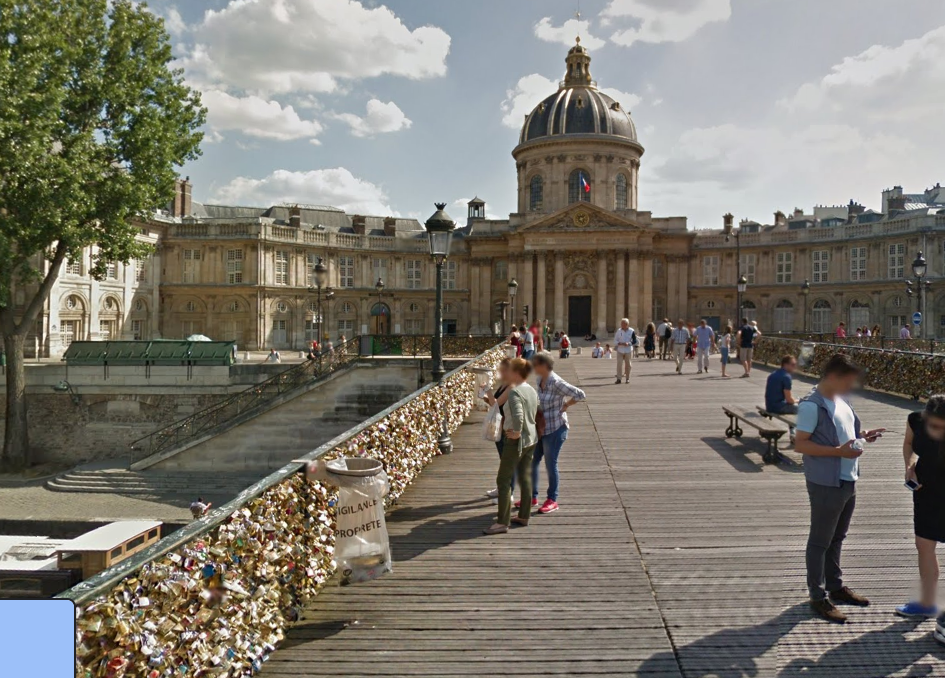
Those sides of the bridge were in danger of collapse so have been replaced with glass barriers which cannot have locks put on them. However, any remaining spot for a lockhold on signs, the streetlights, the safety instructions for the boats below, are still infested by incurable romance. Anyway, we walked on from the bridge, up the side of the Panthéon (worth a future visit perhaps?) down past some very chichi interior design places on the rue Bonaparte to St Germain des Prés and the Deux Magots which I airily translated for the nephew as fag ends but which on checking I see I am confusing magot (nest egg?? “stocky figurine from the far east???!) with mégot. Fag end seemed to fit a little better with Simone and Jean-Paul.
We got on the métro (at this point in the middle of our long argument about how to pronounce it, he thought “meat-ro” sounded more French) spent two more carnet tickets and got out at the tour Montparnasse. After a few false starts we finally went through the right door, got into the fastest lift in France and got out for the amazing views over Paris at night. Just as we bought tickets woman scanning them told us if we hurried we’d get to see the Eiffel Tower sparkling, so we hurried up to the outside deck and indeed saw the sparkle. (We were out walking for so long last night we had in fact already seen it twice, la grande dame de fer sparkles in the dark for five minutes every hour, on the hour). As is traditional, I made the nephew buy and write some postcards and I also had the joy of bollocking someone else’s English teenagers who were trying to buy cigarette lighters in the gift shop. The gift shop staff don’t care, but their teachers definitely will! Do you know the phrase “mauvaise idée”? The café there looked dark and closed and no-one was using it, but the staff got me a coffee when I asked and it was fine to sit at the tables for an hour as night fell.
Then we got back on the train back to digs and found a late night pizza place (Vittoria, Paris 10) for dinner. This nephew definitely did know what tiramisu was (that manky coffee thing that dad likes) and also knew what to expect from a chocolate fondant. Before hitting bed, nephew notices his fitbit is only 1,000 steps off 30,000 so we trudge round another block to get him over the line.
Monday Fitbit says: 26,729 steps, 61 flights of stairs, 19.38km, 4,754 calories
Day 3 – Tuesday (14th Feb…)
(Note to self, Louvre and Pompidou don’t open on Tuesdays, Orsay is closed Mondays)
At this point it is starting to be a little difficult to drag our sorry carcasses out of bed with a spring at 8am, and we both snooze through a few alarms and startle the guy by coming down for breakfast at 09.59 when he is starting to tidy up. Time doesn’t matter today, we have nothing booked until 9pm when we have to find dinner in front of a sporty screen because PSG are playing Bayern Munich.
I am very much appreciating breakfasts made up of cake and cheese. I have not had any vegetables since leaving England. My nephew says orange juice and pizza tomato definitely counts towards your 5-a-week.
Today the weather is brilliantly sunny and we head to the Eiffel Tower. We go to École Militaire and describing it as a kinda French Sandhurst turns out to be entirely unhelpful. This part of town lets me have another look at the Grand Palais Éphemère which so surprised me last year – a temporary palace, housing the contents of the Grand Palais while that is rejuved ready for the Olympics in 2024 (beattie dubs, quite a lot of our trip this time was cluttered with scaffolding as the whole city is getting spruced up for the JO) When the rings swing into town next year, both the temporary and real palaces will be olympic venues.
We walked up through the Champ de Mars and into the queue for the first of two bag checks to climb the Eiffel tower. The staff at both do not really appear to be paying much attention, but I’m sure it’s fine. In the first queue nephew notices PGL staff in uniform, and I say a little too loudly, oh yeah PGL are amazing! and we end up chatting with the staff about the awesome PGL Château and how great they are for school trips. This school group is a bunch of tiny Y5s.
From one queue to another and nephew notices a sign saying top closed. There is definitely nothing wrong with his eyes, he has been spotting things I can barely see and asking ooh what’s that? What’s what? I can’t see anything! When we reach the end of the next queue, buying the walk up the stairs tickets you can’t book in advance, the cashier explains the top is shut because there are too many people, but it might re-open today, tomorrow, *shrug* who knows? She will only sell me a 2nd floor ticket. We climb. I had been dreading this a bit because my knees hurt quite a lot these days, we had already done the steps of the Arc de T yesterday as well as walking the best part of 12 miles. It was not as bad as anticipated. We had a breather on level 1 and took a drink in the bar in the geometric sphere which was filled with gold heart-shaped helium balloons. A bit of a clue about why the summit might be over full today, Valentine’s Day… As we continued to level 2 we passed a man with a backpack hoover cleaning the steps. At level 2 we get views over the city in all four directions and point out the places we’ve been and are going. The tour Montparnasse we were last night, Sacré Coeur which I’ve not planned yet, the balloon in parc André Citroën that is pencilled in.
At this point I’m also mulling over some stats and figs… the signs in the Eurostar said it was 75m under the sea; the Eiffel Tower is over 300m tall and level 2 is 115m. This means we have walked up stairs into the air higher than the chunnel is deep. This seems unlikely. I can see the ground below me, surely the sea is deeper? A bit more googling. It seems Eurostar are a bit confused but the tunnel is 75m below the sea bed and 110m below sea level. At its deepest, Hurd’s Deep northwest of the Channel Islands is 180m deep. If you put the the Eiffel Tower on the sea bed in any part of the English Channel, a large proportion of it would stick up out of the water. The North sea is 700m deep at the lowest point but the average depth is only 95m; the Mediterranean is over 5,000m deep at it’s lowest.
Aaaanyway, back to the main narrative. Eiffel Tower kinda sort of done. The summit is closed so we make do with level 2, then head back down to streetsville. I had planned to walk around the Trocadero gardens, but we are quite late in the day now, and we could see from the air that the fountains were boarded up, probably being cleaned for the Olympics, so we queue for a crêpe and head down the river, and catch a boat. I use Batobus again because we can get out at a different point. We head all the way out and most of the way back and disembark at Hôtel de Ville.
We are headed for the Grand Rex, a large art deco cinema the far end of the Marais. It’s not far, the sun is shining, and we are young so we decide to walk. It’s definitely worth doing. We pass the outside of the Pompidou centre (closed, it’s Tuesday) and the outside of Les Halles which I am amused to see is now Westfield Les Halles, and any number of cafés fleuris, decorated with fake flowers, and a huge graffito of Capitaine Haddock and Tintin snogging.
Finally we find Grand Rex, and pretty much ask at every door where we need to go for Studio Grand Rex. As we walk around the outside, they are laying red carpet for the gala opening of Antman and Wasp Lady, Quantumania. We wonder idly if that means that Paul Rudd is in town. Eventually we find the Studio. This is an interactive tour round parts of the building that takes you through the history of the 90 year old megacinema. Along the way they show you some of the magic of movie making and cinema projection, you get a view down over the actual stage of their largest screen (a 2,300 seater auditorium). They asked us as we bought tickets if we wanted it in French or another language, so we said English, and they said queue here for the English version, your tour will start when this French one has gone in. In fact, we had the whole tour to ourselves, just the two of us, which was awesome but also a little weird, as some of the interactive elements clearly had a bigger crowd in mind. The nephew was dubious at first but the tour won him round quickly and he loved acting out on the green screen and seeing his scene played back. The whole tour ends in a bit of a surprise, but I won’t spoil that for you too much… please go and do this, it’s amazing!
We had a debate about whether we wanted to see a film there that evening, but the PSG match took priority. We needed a viewpoint for sunset for this day so headed for the métro. Nephew started a bit of an obsession with the platform vending machines… can you get what you want out of it before the train comes? Very hit and miss, sometimes easily, sometimes the machines will rob you blind, whether you use coins or contactless. Also there’s a danger you buy maltesers, open the bag and then fling them all over the top deck of a RER while the people nearby laugh at you.
We headed out to the Grande Arche de la Défense for our viewpoint – the plaza beneath it feels very futuristic, not very “Parisian” but very “important big city”. It’s a nice change of vibe, both in the daylight and then after at night. We were there quite a bit before sunset, but there are lots of seats so if you want to sit and wait, that’s fine. There’s no catering here in the evening. The views are super, and you can have a bit of a talk about the Axe Historique and what all lines up neatly here. Also the idea of “golden hour” and starting to understand the phrase Grand Paris, which was new to me, and sounds a little nicer than the proches banlieux. There were hardly any visitors at all, just us, a romantic couple who got a lot better deal than the crowds on the Eiffel Tower on Valentine’s Day, and a crowd of about 6 people who looked like they’d come straight from a work event. It got a bit cold up there but wasn’t quite dark enough for the best photos, so we went inside for the photography exhibition and the gift shop for half an hour. The photos were a mix of the damage and the start of repairs of Notre Dame and a photo essay contrasting the astonishing luxury of the Opéra Garnier and Versailles, obvs, with a hi-rise council estate. We got back outside just before 7pm towards the end of the opening hours when it was properly dark and appreciated the night horizon.
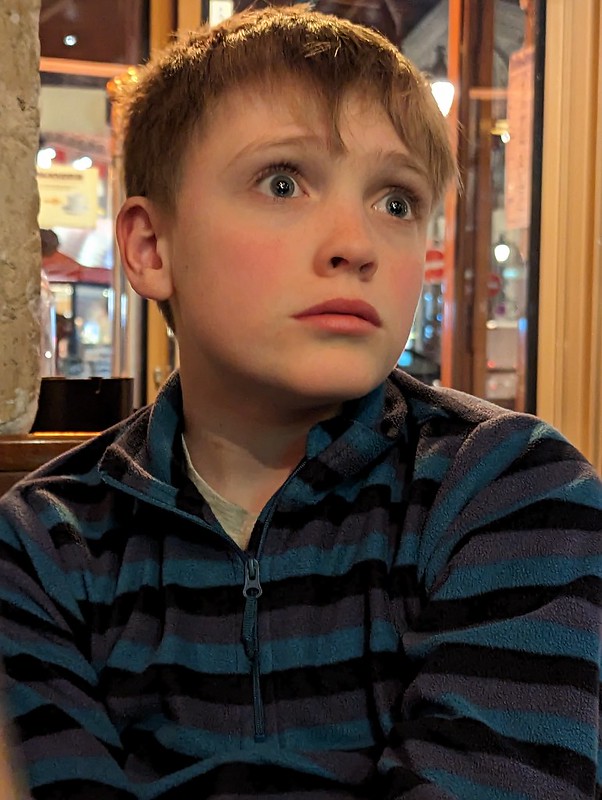
This left us plenty of time to get back on the metro but not at super peak 6pm when the tower block offices were just emptying. A return to the hotel for a brief recharge (of phones!) before finding a restaurant with a TV screen for the match. We went back to Baroudeur Patient outside the Gare du Nord for perfectly respectable, slightly pricy brasserie fare and the kiddo watched the match and I read twitter. We did have a bit of a conversation with two middle aged guys opposite who wanted to practice their English (my aunt she was always the difficult one in my family… she married TWO English guys!! lolwut?) The waiter was keen to impress on the nephew the importance of learning Spanish (oi, mate, seriously?!). The match got very close in its final minutes, the nephew pulled this face:
Then back to the hotel for the closest thing to an early night we got all week!
Tuesday – from Fitbit, 18,882 steps, 13.68km, 65 flights of stairs, 4,053 calories burned.
Day 4 – Wednesday
Nephew had asked to visit Parc des Princes (2 football stadiums in a week!?), which I had never done before, but looking it up on the map it was close to few things that had been on my radar for a while and I’d never done, so it sort of slotted together OK. The visit was booked before leaving the UK for 3pm which left all morning for exploring. We took the métro nearly to the end of line 8, Lourmel, and walked through some interesting parks and neighbourhoods on the way to Parc André Citroën, on the site of a former car factory. I have meant to visit this park for ages, having never got around to it while I lived there in 1999. And now I have to go back because I feel like I’ve seen its winter bones, but not the flowers and colours and fountains that are its main summer features. We were visiting to fly the Ballon de Paris, a tethered helium balloon that climbs up to half an Eiffel tower and does lots of air pollution science. (It rose to 150m, which was higher than we had actually managed on Eiffel Tower day) There were no queues… in fact on our brief flight, the balloon didn’t take off on time because it was waiting for more people. We ended up about 10 of us in the air, and balloon gently twisted so we could take in views in different directions, before silently and smoothly coming back down again. Then we walked the park, saw a single duckling surrounded by Parisians concerned that its mother would not be able to get it out of the water without some kinda ladder (I think a sensible concern – the water features all had concrete overhangs which meant there wasn’t a walking route out for tiny duckling legs). Park and mairie staff in uniform did not share the concern. We didn’t go in the greenhouses. The park is organised around some themes… go read the wiki page.
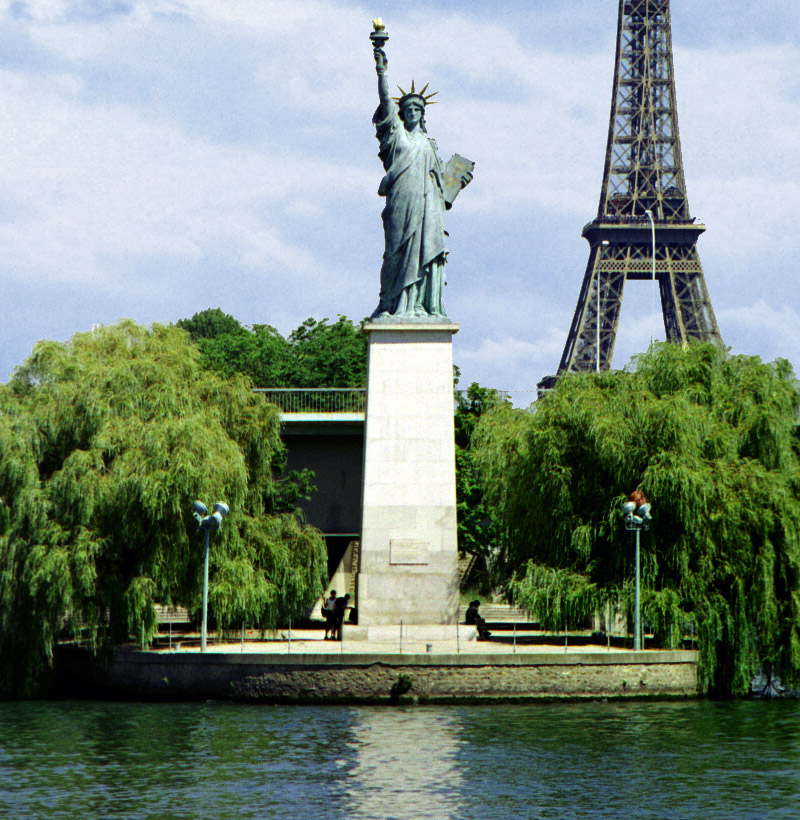
On from the park to quite a walking day – it’s just a few steps away to a small model of the Statue of Liberty, at one end of the Ile aux Cygnes. The island is small and not a lot going on, there’s some outdoor exercise equipment that creaks and groans, and there’s plaques and things to read. I tried for a while to get a photo with lady Liberty and la grande dame de fer, but basically I think you have to be ON the river to get this shot.
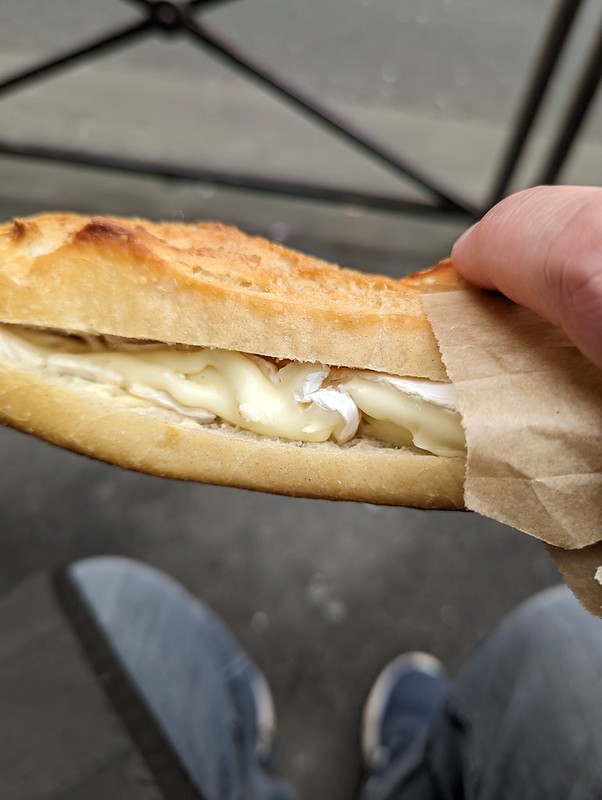
So we walked on towards parc des Princes, at this point with a lot of time to spare we were also keeping our eyes peeled for a neighbourhood boulangerie whence we might procure yet another baguette jambon fromage. We passed a few but they looked a bust – some of them had everything but – but the final one we tried, just around the corner was the ticket. It was a curious place, it could have been straight out of my 1980s childhood with just the addition of a contactless coffee machine. There were very few people in there but it took a long time to get served. When we got to the front the lady instantly detected my non-French accent and attempted to switch to English but unfortunately her English was pretty ropey and communication was poor. Eventually I switched back to French and made myself clear and she was like, oh you DO speak French. Oh, you speak French well! I have some little things I do if anyone ever says this to me, having been corrected on a campsite in Normandy in 2006. You can’t say je fais mon mieux, I do my best with all the words translated straight up. You have to say I do OF my best. Je fais de mon mieux. She eventually went out the back to fetch the jambon and fromage at which point the person behind me in the queue said in French, actually I think you speak French really well, I understood you perfectly, so I wheeled out my next fave, ah monsieur vous êtes trop gentil!
We sat on a bench in the street for our baguettes – I had gone for camembert:
Then on to the stadium. There were a lot of people – it looked like two school trips had just dropped off their students, so there was much milling, and indecision about where to queue. Eventually the teenagers were marshalled away and the door became clear and we wandered in and got stuck in another queue. It became clear we were in the greenscreen queue for fake pics with footballers, which we didn’t need, so we bypassed and got stuck into the “sens de la visite”. It was a self guided tour, follow the signs, look at the places, no guide, just some bouncers keeping us on the right side of the barriers. You sauntered through the pitch, the stadium, the press scrum place, the changing rooms, up to some extremely glitzy VIP boxes, past a very full trophy cabinet. It was a bit chaotic – it would not be fun with a school trip because there were lots of chances to wander off and merge up with other people. It was not nearly as well as organised as the S de F and there was no guide with celebrity gossip, but there were many more people there and the football fans seemed to find it more meaningful.
Then we had to go to the stadium shop. Which was awful! Nephew was trying to buy tops for his friends, having been whastapping them about nothing else for days. But the shop was not well stocked, so compromises had to be made. There was a terrible queue that snaked all around the shop to get to 4 rude cashiers (many more security guards). Frankly everything took much too long and I was glad to get out, get on the métro and return to the hotel for the briefest of sit downs.
The dusk view point for Day 4 was Sacré Coeur, and so we… walked there on an already very walky day. And then wimped out of climbing the worst of the stairs and went up the funicular instead. We had a nice time admiring the views, the love locks and the souvenir shops, and then wandered around the square at the top. I had been hoping to find a cartoonist to draw a pic of the kid – last year I sent the one made of his brother to his mother, and I’d imagined getting the next one to make a set. But no artists were available – there were much fancier portrait painters but no caricaturists.
So for an evening activity… well, we returned to the Grand Rex, via a terrible burger and crepe shop directly opposite. It was still Ant Man in the Grande Salle, in VOST (version originale sous titrée, ie in English with French subtitles.) I don’t think I saw anything with Wasp Lady in it although I think I saw the original Ant Man, but MCU is fine for dropping in and out of. The place was packed with over 2,000 Marvel fans so there were dramatic gasps and whooping and the whole place went nuts at the post-credit reveals. It was exciting to see a film with so many fans again. I was vaguely annoyed at never having been here before: my Paris studies included a film class that made us go to the cinema every week, and I went a lot more than that, to screens all around Paris. And somehow I never heard of Grand Rex, which is such an exciting venue. I was so excited about it I even looked up the future screenings to see if maybe it was worth returning for a weekend with just the plan of seeing a big premier. The list includes lots of American titles, many MCU, Dune II…
We went for a very late showing that kicked out well after midnight and as we came out we found the road closed to traffic with a lot of work going on as it was being resurfaced. A quick play with my phone maps and we found out actually, it really wasn’t very far from our hotel on foot, so we got even more steps and walked back to base.
Wednesday – from Fitbit, 26,426 steps, 19.19km, 43 flights of stairs, 4,483 calories burned. (Wednesday was the day I got my 70k steps!)
Day 5 – Thursday
The night before we didn’t get back to the hotel until nearly 1am so I was again in no hurry to get to breakfast. The Nephew chose to eat a kiwi fruit, an action so out of character I took a photo. This being our final day we knew whatever we had planned we had to return to the hotel to collect bags before too long. The choices were the Pompidou centre or les Invalides – both places I had walked past the outside of many times but never actually been into. I opted for les Invalides in the end. It’s really shameful I had never been before as my digs when I lived here had a very close view of the golden dome and I walked past it practically every day. I think there are parts you can visit without paying – the corridors, the soldier’s cathedral, the shop and café; but we also visited an amazing display of armour and weapons and the Tomb of Napoléon, which is… really quite something extraordinary.
We went for a coffee and a snack in a nearby café and a quick walk down back streets to the now extremely chichi rue Cler which was once my local shopping street before heading back to the hotel. Before we checked in for the train we went hunting – a house in the same street as the hotel is one of those mystery ones bought by the Métro and converted into ventilator shafts. Up close if you know it’s there, it’s not hard to spot which one it is.
We bought more cheese and ham baguettes to eat on the train and checked in for the return journey to London. The terminal was crowded and chaotic and there were frequent announcements to warn us that most of the toilets on our train were out of order and to make sure we used the station facilities. Which was pretty poor, but made worse by the fact that also, most of the station facilities were out of order too.
Onto the Eurostar, successful parental hand-off at St Pancras and then as one last treat before heading home to Nottingham, I met up with a friend in London for some transport highlights. The Elizabeth Line! The DangleWay! How exciting!
Thursday – from Fitbit, 16,012 steps, 11.59km, 34 flights of stairs, 3,795 calories burned.





































 Niles's Blog