Solar panel performance – 2014 and 2015

Forgive me reader, it’s been over two years since I last blogged the annual performance of my solar panel.

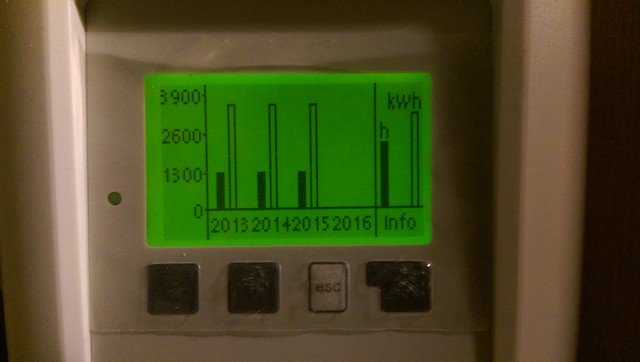
Solar panel performance 1/1/16

A photo this time rather than a screen shot as since I upgraded my computer I have been unable to re-download the software that would allow me to connect my new computer to the controller. This is rather annoying because I paid extra for the computer control facility.

Rather suspiciously, the controller reports almost identical kWh outputs for the last three years.

I will estimate it as 3,800 kWh per year. Nottingham Energy Partnership have an Energy Costs Comparison table. I neglected to look at it last year, so will have to use the data from last month now to estimate the financial value of the heat we got from the sun. I use the gas rate of 5.19p/kWh, since if the water were not heated by the solar panel, it would be heated by gas.

That means the solar panel gathered around £197 of energy in each of 2014 and 2015.

The running total to the end of 2014 is therefore £1,187 and at the end of 2015, £1,384.

September will see the ninth year of operation. When it was installed, we needed to put in a new hot water tank which was bigger than the old one, so the installers had to demolish my airing cupboard to fit it in. In the nine years since, I have yet to sort it out.

There are all sorts of flawed assumptions being made to come to that figure, so take it with a fairly large pinch of salt.

If you are considering a solar panel of your own, whether for hot water or to generate electricity, and you live vaguely near Nottingham, do please get in touch with Sungain at Nottingham Energy Partnership, who would be delighted to let you know what to do next. You can also follow them on Twitter, and they also have a very helpful service on their website that lets you compare your electricity and gas tariffs and see if you can save money.

Buckets more information about my own solar panel under this link.

And a declaration of interest: I’m on the board at Nottingham Energy Partnership, where they very kindly describe me as an “energy expert.”

French and German weather haiku

I wrote these last year in July as we were approaching a weather topic.

My aim was for Y7 students to make sure they understood them, then translate them into English, then fiddle with them until their English versions also met the syllable pattern to be a haiku.  This proved incredibly hard to explain!

Looking again at what I wrote after 9 months have elapsed, I still quite like them.

The ultimate aim is for students to write haiku of their own in the target language. This is a stretch for many.

Working with haiku in French and German is something I first did on teaching practice and is not really something I have managed to embed.

Please let me know what you think of these haiku – especially language errors, should you spot any.

En avril, il pleut
La pluie mouille la terre afin
que toutes les plantes poussent


Soudainement, la
pluie s’arrête. Puis le soleil.
Un bel  arc en ciel


Coup de foudre et
Le ciel de nuit s’éclaire
Des gouttes de pluie tombent


Quelques mois sans pluie
Des grandes fissures dans la terre
Temps de secheresse


L’hiver s’approche vite
L’automne est déjà parti.
Les arbres sont nus.


La planète congèle
Le lac et la rivière
Sont durs comme le plomb.


Die Klassenzimmer
ist so heiß wie ‘ne Wüste.
Ich brauche ein Eis!


Bald ist es Winter.
Die Bäume sind total nackt.
Herbst is schon vorbei.


Winter gibt es Schnee.
Frühling und Sommer, Regen.
Nur Herbst ist trocken.


Während des Tages
hat es heute geregnet.
Ich will draußen geh’n.


Heute morgen – Schnee.
Der Schneefall mag ich gucken.
Weihnachten kommt bald.


Schwitzen und streiten,
Beim sonnigen Wetter kann
Nichts gut herauskomm’n


Regelmäßig kalt.
Ohne Mantel nicht ausgeh‘n!
Handschuh‘ braucht man auch.

Diner à deux

Another opportunity to cook for a friend. As ever, starter and pudding ideas come easily to mind and coming up with a main is a little more challenging.

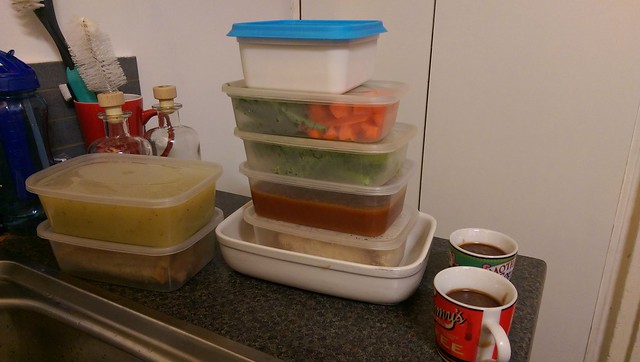
Tonight it’s potage parmentier – 3 leeks and one huge baking potato simmered in stock with a parmesan rind (thank you Julie/Julia) and some herbs, served with a swirl of cream and slices of the breadmaker bread mix loaf (“homemade” stretching it a bit) that’s on the go at the mo. Chicken breasts poached in stock (my friend is teetotal) then baked in homemade tomato sauce and strewn with cheese, with green beans, carrot batons and broccoli.

And the pudding is a chocolate chestnut ganache. In a French hypermarché years ago it seemed like a good idea to buy a multipack of little tins of Clément Faugier marrons glacés de l’Ardèche, in beautiful traditional blue and white designs, and I’ve been baffled about what to do with them ever since. I plumped on the idea of adding them to a ganache to make truffles as I was preparing something to take with me to Hogmanay in Scotland and it worked reasonably well. My first attempt with 150gr milk chocolate, 150ml of double cream and one little tin of chestnuts would have been fine as a chocolate pot to eat with a spoon but was too soft for truffling. Remelting with a further 50gr of bitter dark chocolate I had knocking around was enough to get the consistency right, but by then it was too late to form the truffles so I carted the lot off to Scotland in a recycled takeaway tub.

Since we are not eating chez moi ce soir, I’ve boxed the lot up for transportation, again in those hardworking recycled takeaway tubs. It was under an hour’s cooking at home and getting it on the table will be less than 30 minutes. There’s lots of spare soup and chocolate for later in the week.

Dinner for 2

This week an old friend posted on Facebook about chalet jobs in the Alps. I’ve had little fantasies about this kinda work ever since I heard about it. You spend a week in a chalet for 6 or 8 or 12 providing all the hot meals for the residents – a cooked breakfast, afternoon tea for when they come off the slopes, and then a full home cooked meal in the evening. I’d love to have a go at doing that for a season, even if I would almost certainly be terrible at winter sports, just for the cooking aspect. Of course it would be incompatible with paying a mortgage on the house in blighty and there are all the animals to look after so it’s not anything I’m going to move into any time soon, but… one day maybe?

Project Dressing Room

Now that I live alone I have a spare room that was previously P’s office. It’s only barely big enough for a bed and was a box room when we bought the house ten years ago. I wasn’t entirely sure how to use the space when he left it entirely empty and beautifully clean, but my thoughts had been edging towards turning into a dressing room, or a giant walk-in wardrobe.

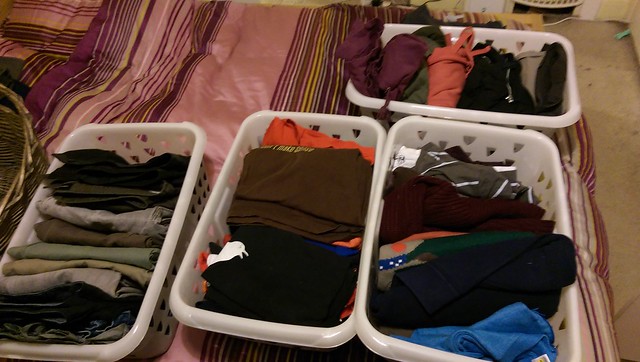
I wasn’t entirely sure how I could do this. I wondered about getting someone to build something simple out of scaffolding poles and MDF to make boxes – I’m a big fan of shelves for clothes rather than drawers. My clothes until now had been living in a mix of built-in wardrobes and open rails from Argos in the corner of my office. I’d recently innovated so that things that didn’t need to hang lived in cheap Ikea laundry baskets on the floor of the built in wardrobes.

Clothes baskets

A more expensive solution would have been a pair of Ikea wardrobes with all the fixtures and fittings. Two problems – one, it wouldn’t be impossible to end up spending a grand doing that and two, P had a wardrobe up against the external wall and it led to damp and mould.

This mould is where a wardrobe was next to the wall. What's going on here and how do I stop it?

That took about a year – he’d had worse problems before with more furniture closer to the walls. This is an old, single skin brick house and that room has two external walls.

I’d spent a couple of months wondering about it and idly googling, but everything I’d found so far was high-end, luxury spec sort of thing – because I suppose most people with the space for a dressing room are not short of a bob or two.

What made the difference in terms of getting the answer I wanted out of google was to add the search term “warehouse” – this mean the answers I was getting were a bit more high-volume, low-price and less hand-burnished rosewood with a mahogany trim.

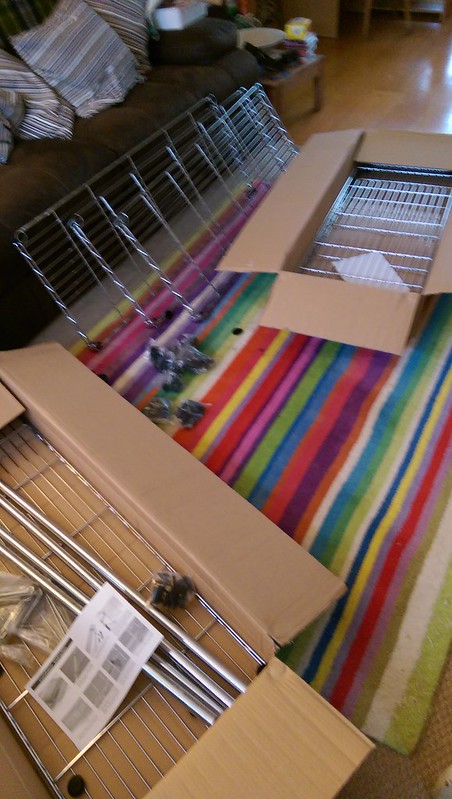
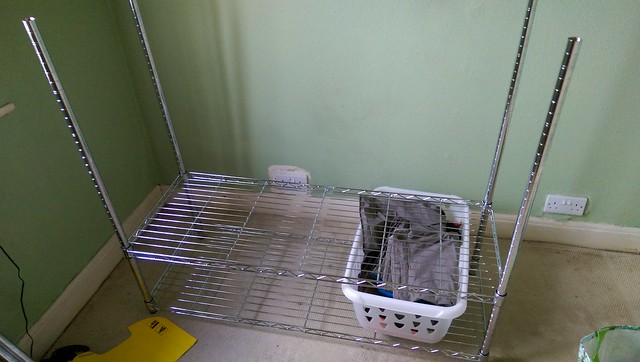
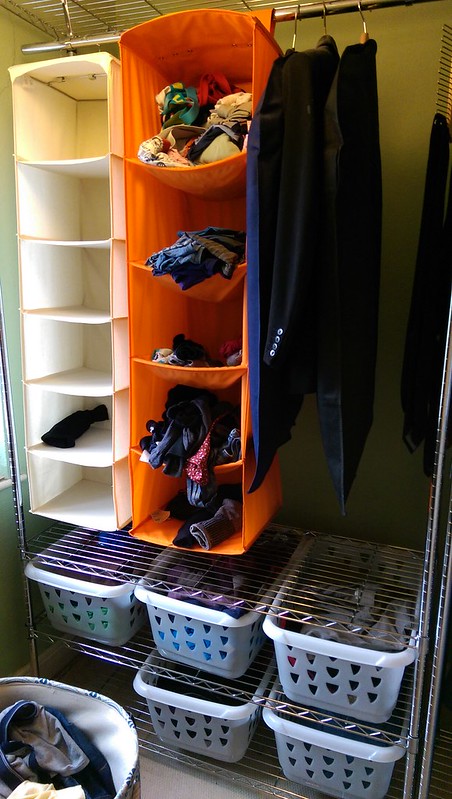
The company Shopfitting Warehouse was what popped first and they had a whole series of chrome garment rails that are intended either for warehouse or shopfloor, but which are very well priced and don’t look cheap. They fixed almost all of the problems – free standing, so can stand away from the wall to allow airflow and to check and clean the mould if necessary. They can easily be moved around the house into other positions if necessary. Very easy on the budget. Modular, so I can configure them exactly how I want them. I ordered a couple of units on the last day of term and they were delivered bright and early on the first day of the holidays. I’d built them and put all of my clothes onto them within 90 minutes.

Project Dressing Room

Project Dressing Room

Project Dressing Room

I can’t quite get a picture showing both units together because the room is so small I can’t stand far enough away. But I am distinctly chuffed. I have more clothes storage space than I have ever had and more than I need, even for the obscene amount of shirts I own. And all for less than £200.

Project Dressing Room

Project Dressing Room

(Now to go and get 15 shirts back from the cleaners and drop off another 15, and do two loads of washing. Hmm, that will fill some of the spaces…)

Lifeboat tasks

When I was on teaching practice a senior leader introduced me to the concept of a lifeboat task – something to have in reserve for the times when the class in front of you finishes all the work you had planned in record time.

The concept was not introduced in time to save me from a very long and desperate game of hangman with some very able Y7s who must have finished their secondary education by now.

The best of these are ideas that need very little prep, and there is a super document on the TES of “minimum preparation, maximum effectiveness” tasks that did the rounds in my PGCE year and which I definitely recommend.

The simplest of my lifeboat tasks is a game of noughts and crosses or connect four where each square in the grid has the initial letters of a sentence that has been worked on in the lesson, eg “HSJRGD” as a cipher for hier soir, j’ai regardé Grand Designs. Students have to guess the sentences before drawing a naught or cross for their team.

But I also have a small selection of simple printed resources that have helped me out no end from time to time when the class is quicker than anticipated.

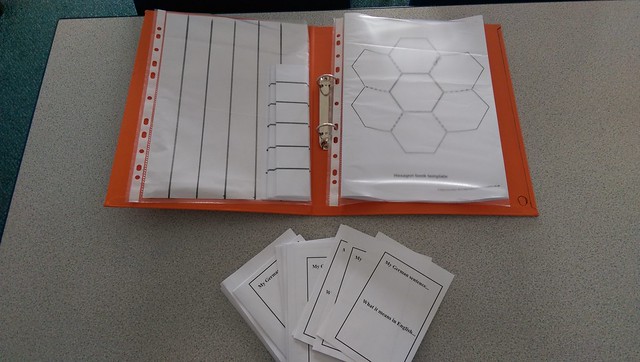
my lifeboat task file

Clare Seccombe’s hexagon booklets

I have a wodge of blank hexagon booklets that students can use in many different ways. This works as an extension task for fast finishers as well as a whole class lifeboat task.

Follow the link above for Clare’s template PDF and some examples of how to use it. (telling the time, verb conjugations)

It’s a great example of HOTS not MOTS (higher order thinking skills not more of the same) because you can get the students to consider it as a teaching tool.

Lifeboat tasks - strip bingo

I have some blank sheets for playing strip bingo on, made by simply drawing horizontal lines on a landscape sheet of A4 and guillotining into strips. Students put one vocab item from the a constrained list into each square. You call out the vocab items. Students are only allowed to score the two outside squares of their sheet, so you have to have a way of calling the same vocab item more than once (return the paper to the hat, for example.) If you call the item from the outside of their strip, they tear it off. You have to be strict about keeping the discarded paper safe ready for throwing away and not making a mess with.

Students get excited at the name of the game – strip bingo – so I make a point of clearing up that it’s called that because it’s played on a strip, not because anyone will have to remove clothing.

It ought to be possible to play this game without providing a preprinted strip for the students, but I find they do not listen to instructions and many do not draw the boxes so they can tear the strip off properly. At least the first few times through, it’s quicker to provide them with a sheet.

The same is also true for my final suggestion, aural dominoes. For this, students pick a sentence from their work, which they write in the target language and in English on a small sheet. They then tear the English off, you collect all the English strips, and you get them to pick a new one at random. Then it should be possible for a student to read their TL sentence, another student to hear and understand it, and read the English translation, and then start a chain. Each new student reads aloud the English of the TL sentence they have heard before then giving a new sentence which someone else in the room should have the English for. This can be quite a long activity – up to 20 minutes – until the students are used to how it works and get a bit quicker.

Aural dominoes template.

What are your go-to lifeboat tasks?

Further ravages of time

Slightly under ten years ago, I renewed my passport.

Now I’m preparing to do it again so it will be definitely back with me in time in case I get to go on the school trip to Paris in December.

I didn’t quite dare tick the box that says my appearance has not substantially changed since last time.

passport photo

passport05

passport96

Disaster cakes

Preheat an oven to… what was it last time? I think I did it at 180 but I can’t remember if that was too high or too low? Try 160 just to be on the safe side

Weigh three eggs, and add the same weight of fat, self raising flour and sugar to a bowl. I use vegetable oil to save having to faff with getting butter to room temperature without melting it, at a fraction of the cost and without too much taste compromise. I was supposed to be using caster sugar but somehow someone put granulated in the caster pot last time it was refilled so I suppose that will have to do.

Zest a lemon – cripes, that one’s in a bit of a state, oh well, it’s what we have. Joe Public won’t be able to taste it by the time it’s cooked – into the mix and stir until well incorporated.

Spoon the batter into 12 cake cases, realising towards the end that whilst this mix usually does 12 easily, this time it looks a bit hit and miss and there’s only really enough for 9. Oh well, the first six were a bit over full and will probably spill in the oven so I can spoon two tea spoons out of those into the remaining cases. Oh drats, the case came away with the batter and now there’s bits of cake mix all over the tin. That will be a bugger to get off later.

Cook for I dunno 15 minutes? 20?  Check they’re not burning after 20 but they’re nowhere near done so turn the oven down, or maybe up? after that and put them back in. They’re done when a skewer – where the heck have all my skewers gone? Oh there they are – comes out clean.

Leave to cool while you watch Only Connect.

Put a pointy nozzle in a disposable piping bag and place inside cocktail shaker. Spoon in a few dollops of home made lemon curd. Pff, yes of course shop bought will do. Pipe the curd directly into the centre of the cupcakes with a firm pressure and oh god there’s lemon curd everywhere, all over my hands, oozing over the top of the bag, and out around the nozzle instead of through the hole at the end.

Neatly use a teaspoon to cut holes in the remaining unruined cakes and spoon the curd in before placing the top of the cake back on and hoping the crumbs don’t make too much of a mess.

Juice the lemon you zested earlier and add icing sugar to make a fruit icing. Not that much icing sugar you dolt! Eek, this is very firm, it won’t spread at all. Oh, well, it will be fine. Normally it’s too runny anyway. Spoon the icing over the cakes taking care not to… oh… the bit you cut out might come away a bit. Yes, there will be a horrid mix of icing and crumbs and it will look awful.

Garnish with jelly lemon slices, which for no good reason are not on sale in Sainsburys any more and don’t seem to be found for love nor money anywhere other than Evil Amazon. These jelly lemon slices were actually ordered before the summer holidays and have been sitting in my pigeonhole for six weeks, but they don’t seem particularly harmed and are still well within their date so meh.

Select six of the least worst looking cakey horrors and pack them in a box for work tomorrow.

Disaster cakes

What I read over the summer (tl;dr 7 crime novels)

Nothing that isn’t crime fiction or magazines!

I am currently working my way through several series of novels on my Kindle as a way of absolving myself of what to read next. No agonising decisions, just the next one in one of the series. Most of what I read fit that criteria.

I am particularly liking Evil Amazon’s new (?) thing where they have a page with all of the books in a series, in order, so you can check what you have and whether you’ve missed any. I am even still at the start of some of these series so have many hours of reading pleasure ahead of me.

In a tent in the Peak District, instead of going on a rainy walk, I finished P D James: A mind to murder. I loved the period detail – the bureaucracy of how a clinic used to be organised, and little details like the building the crime takes place in still needing its own switchboard and operator with potential for eavesdropping.

I began C J Box: Three Weeks to say Goodbye and finished it on my sofa when I got back. This is not part of Box’s – Joe Pickett novels, but a standalone thriller in which bad people try and get back an adopted child. It’s a thiller with the page-turner impulse brought in through one average guy’s attempts to protect his family and the lengths he will go to do so.

Whilst camping dahn sarf my old Kindle failed – the buttons became unresponsive. This has happened to me before but has been fixed by charging. In the field, this wasn’t possible as I was camping without power.

I did take a paperback with me for just this eventuality (in fact I have been carrying it around for ages, and it has somehow in my bag got food mushed into the pages and the front cover. A raisin, I think. I hope.) so the next book was a classic. Raymond Chandler: Farewell my lovely. Part of the Phillip Marlowe series, but I am not sure if I have read any of the others. I suspect I have them on a shelf somewhere. It took a number of pages to get used to the old slang used, but as is often the case, after a while I read so fast I am not puzzling too much over new words. I guessed an important part of the plot a page before it happened – perhaps just because of a slightly clunky plan. The stated reason is not quite enough to invite character X to character Y’s flat – there must be another dénouement afoot.

I couldn’t quite resist pre-ordering and reading Sue Grafton: X pretty much as soon as possible. I think for each of the previous 24 books I have waited till the paperback edition, but in the early days I was many years behind the publication dates. Now I’ve caught up I want to read them as soon as I can! This was in my view a return to form for Kinsey Millhone, without extended passages in the third person, but a narrative almost entirely from Kinsey’s perspective, in which she solves a number of cases, not just the main one.

Sara Paretsky: Blood Shot was next up, slightly out of sequence as for a minute I couldn’t find Bitter Medicine on my new Kindle. It was there so I went on to read that one too. The V I Warschawski series also has some patterns emerging. Almost any documents that get removed from somewhere and left in her flat or office will lead to a burglary. She also takes an awful lot of beatings. In book 5 of 17 she has been routinely injured in the course of her work, including this time a facial scar, that by the end she must be in a seriously bad way.

The new Kindle is lovely. I realise it’s just a machine to make me funnel more money in the direction of Evil Amazon, and there are alternatives available. Some even waterproof! But I have a lot of unread books on the Amazon system already and it just works quite well, so in the end I stayed with them. Now… what to do with the old, probably broken 2010 Kindle Keyboard device?

My final title here – although it is warm and sunny so I am about to head into the garden with the hammock and start another – is a Ken McClure / Dr Steven Dunbar novel. I found the first of these by accident a few years ago- in fact I can remember reading them on Kindle on my own on Shell Island, so that must have been the holiday I took immediately after losing my council seat in 2011. I don’t recall ever talking about them with anyone or hearing about them from anyone else, but they’re brilliant. They follow a former SAS doctor and his exploits with the Sci-Med directorate, a secret home office body that lends technical support to local police forces out of their depth with scientific or medical issues. Eye of the Raven starts with a detailed deathbed confession from a convicted psychopath of a rape and murder for which someone else is already imprisoned on dead certain DNA evidence, and explores how it might be possible that the DNA evidence is not all it could or should be.
Found poetry

This is a piece of writing from the website “Streetlife”

It reads to me like a poem. I wonder if that was the intention.

It was formatted exactly like this in the original.

Credit: Ali R

I do running in sherwood ,
but With the Dogs who’s
Owners, have let them off there leads,!!
it’s difficult
Surprisingly Friendly! but intimidating when they jump up snarling and barking
At Me
When 1 go’s another one comes!
its like a b***dy incestation!
I’VE NOT GOT
ANY SAUSAGES,,!!!
???????

I am particularly fond of the cracking malapropism “incestation”.

Pudding club: speculoos trifle

When on holiday in Brussels over Easter we found many speculoos desserts on the menu in cafés and bars. It was a common flavour in icecream parlours. Heading out for a late night beer in the Grande Place and a speculoos trifle slash tiramisu was on the menu.

The spread is now available in larger Sainsbury’s and has been for a couple of years, and so is no longer something I have to stock up on in French supermarkets. It wasn’t so readily available when I made an online supermarket order and they brought the biscuits instead.

This recipe was half made up, half inspired by browsing these French recipes and a website somewhere that included savoury ones (eg lamb tagine where you add crumbs of speculoos biscuits with mint leaves and olives at the last moment.)

Speculoos is gaining in popularity – Olive magazine recently had an interesting looking cheesecake with a speculoos crust.

This speculoos trifle slash cheesecake tastes absolutely delicious but looks... #puddingclub

Speculoos trifle

Yield 6

1x 250gr Biscoff / Lotus biscuits
75gr salted butter
half a jar lemon curd
half a jar – 200gr smooth Speculoos spread
250gr mascarpone

Reserve three biscuits and blitz the remainder in a food processor

Melt the butter over a low heat and add the biscuit crumbs. Stir well

Divide the biscuit base between six ramekins and press in.

Chill a few hours until the base is firm. (Not essential, but it will help avoid the crumb coming away in the next step)

Spoon a dessertspoonful of lemon curd onto the top of each biscuit base.

Combine the speculoos with the mascarpone and stir until well combined. (You may prefer to leave it lightly mixed but well marbled?)

Pipe the speculoos cream onto the base. Chill again.

Break the reserved three biscuits in half and use to garnish.