Summer of smoothies

So this summer, we have been making a lot of smoothies.

I’ve resisted them for years, because I assumed they relied on using those punnetts of expensive soft fruit, often flown across the world, and out of season. But somewhere on the internet, I got given the idea that bags of frozen berries work just as well, and can go straight into the blender from the freezer.

The frozen fruit is far cheaper than the fresh Class I stuff at the front of the supermarket, and so for the last couple of months I have kept my freezer stocked with berries and the blender in almost daily use.

My supermarket has a variety of berries, and we have mostly been using frozen cherries and a blueberry/strawberry mix. The black forest bags look like they ought to be delicious, but they are chock full of seeds from raspberries and they get stuck in my teeth.

The average smoothie is made with about 80grams of frozen berries, a banana, a small spoon of oats, and enough milk to get the consistency right. There’s two of your 5 a day right there! All of the ingredients can be room temperature, so long as the berries come right out of the freezer, and it still makes a nice cold smoothie without the need for ice.

I have been using these remedially when I am conscious that my diet has been poor and that I am nowhere near getting enough fruit and veg in. In extremis, some days I’ve been making 4-fruit smoothies by adding in canned fruits – the cheapest supermarket basics in the tinned pear and pineapple ranges. Since they’re going to be bashed into pieces, it doesn’t matter what size is in the tin.

Tractor, trailer, combine, bailer: Hereford Rap

Liberal England’s recent post promoting a Shropshire rap reminded me that while we were in France our hosts told us about a Hereford rap that was quite entertaining.

A quick search and Youtube has the file, with the rather catchy refrain:

Tractor, trailer
Combine, bailer
Rotivator, cultivator
Sh*tspreader, plough!

The words and the content pursue some rather adult themes. But it is nice to see all those photos of Hereford cultural landmarks. And an indication of how long I have been gone. A Primark? In Hereford? You’ll be telling me there is a Starbucks next.

How does the Olympics make you feel?

News reaches me that the authorities plan to use the London Eye to project a Twitter snapshot of how the nation feels about the Olympics every night the games are on.

What colour the wheel changes to and how much of it is lit up will reflect an analysis of millions of UK tweets for whether they are broadly positive or broadly negative.

Which strikes me as a bit of a gamble. Presumably the object is to show that people are enjoying the endeavour, but my own sense is that most aren’t. There are two people in particular in my Facebook timeline who are enthusiastic about the Olympics, but then they both have jobs at the games and so Mandy Rice Davies applies. Everyone else is spectacularly Eeyorish about it, as this wonderful New York Times piece explains:

LONDON — While the world’s athletes limber up at the Olympic Park, Londoners are practicing some of their own favorite sports: complaining, expecting the worst and cursing the authorities.

Asked “What do you feel about the Olympics?” the other day, a random sampling of people here gave answers that included bitter laughter; the words “fiasco,” “disaster” and “police state”; and detailed explanations of how they usually get to work, how that is no longer possible and how very unhappy that makes them.

The piece goes on to describe the Daily Mail as having the unofficial motto “What Fresh Hell is This?”

One of the main reasons for emulating the anhedonic donkey is there are just so many reasons why the Olympics might make you feel grumpy: the London focus; the cost to the taxpayer; the militarisation; the sponsors (“some of the worst corporations in the world“; the stuff about brand protection – whether or not true; and the exhortation only to write nice things about the Olympic website.

I am hardly the person to be objective on the issue of the Olympics as I don’t actually like sport of any kind at all – and yet even I have been a little tempted to try and get tickets to something to see what all the fuss is about. Far less to actually watch any sport happening – I really don’t give a rat’s ass – but I am quite keen to see what all the fuss is and see the Olympic Park from a urban planning perspective. It featured on Gardener’s Question Time and sounded interesting. I’ve visited, for example, Munich’s Olympic Park, mainly to climb the Olympiaturm, and that piqued my interest. How long will it be – if ever – before London’s Olympic Park is opened to a wider public? Will anyone ever be able to climb the crumpled rollercoaster without an event ticket, or will the whole thing be dismantled and boarded up as soon as the Paralympics wheel out of town? (Loads of tickets left for the Paralympics, if you wanted to get to see the site and/or experience the Arabfly Dangleway.)

When the torch came to town, I did sort of go and see what all the fuss was about – by being a bellringer for the occasion as the torch came past one of the churches I ring at regularly anyway. I was grudgingly impressed by the huge number of people who turned out to see it, and the city was incredibly fortunate with the weather – just hours before, rain had beaten the torch back into the van in Mansfield, soaking dozens of the kids I taught a few months ago, and yet in Nottingham the glorified cigarette lighter got blazing sunshine.

It’s just my abiding thought about all of the trappings of the Olympics – the torch parade, the park, the building projects, the precision of the planning, which has taken hundreds of people to do, the faffing in the regions – is that this is all something of a huge waste of human endeavour. What could be achieved if all this money and good will could be put to use for something more worthwhile?

But then that is what I think about sport more generally, so perhaps I’m not the best placed person to judge. And it’s not as if I have any actual suggestions as to what that more productive thing might be, so perhaps I should just shut up and let the enthusiasts get on with it all.

Speculoos / Spekulaas

I only really know about Speculoos biscuits as an accompaniment of espresso or café coffee. Order a coffee, and get a lovely little spicy biscuit wrapped in plastic. I’d mostly thought of it as a ginger sort of thing.

If you like your speculoos enough, you can buy the same biscuits they use in cafés here on Amazon.

Also recently Time to Cook Online Blog gave a recipe for making your own Spekulaas biscuits, based on a Dutch recipe, where they are common. In the Netherlands, you can buy the spice mix, but elsewhere you just have to make it yourself. I’m not rushing to do it because either my pestle and mortar are not very good or my technique is poor – it goes all over the place! I’m not in a hurry to grind cloves by hand.

Interestingly, Time to Cook does not list ginger as one of the spices in the mix – but the Wikipedia page does.

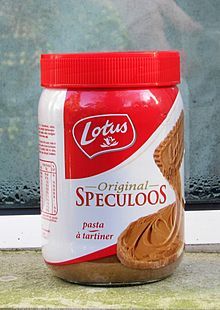
Jar of spread with red and white labelThe reason for my renewed interest was a trip to a French hypermarket while we were in Normandy last week. In addition to the classy French food and booze and the crate full of French stationery destined for the classroom we bought, we also strayed in the “Pâté à tartiner” aisle where there are things to spread onto baguettes for French children’s tea time. We swooped on some Cora own brand white chocolate spread and then eagle-eyed P also spotted some Speculoos spread.

Once we got home we found it’s delicious! It almost has the colour and grainy texture of peanut butter but is sweet and spicy. The jar will not last long in our house and it’s all we can do to remember to spread it on bread and not just eat it out of the jar with a spoon. I haven’t seen it in UK supermarkets, but you can buy it on eBay. (Also available in crunchy!)

Whilst searching for the spread, I also found on Amazon this Speculoos syrup – similar, I suppose to the sort of syrup Starbucks use to make a gingerbread lattè. Another suggestion for its use is to flavour whipped cream. Delicious suggestion.

Photo credit – Charles01. PS is it ok to link to images hosted on wikipedia or do I have to copy them?

Non fic stories

Most of what I read for pleasure is fiction, and almost all of that, for almost all of the time I have been an independent reader, has been detective stories of one sort or another.

But in the last few years, I have started to branch out a bit into reading non-fiction for pleasure. And there’s a sort of new genre I have come across – or at least new to me – of a weird sort of travelogue / nonfic hybrid. Nonfic authors essentially writing stories that happen to be true, but have the readability of fiction. And maybe also footnotes.

The first I really bumped into were Mary Roach. I can’t now remember why I started reading her, but her books are brilliant, about all sorts of unsavoury subjects. There’s Stiff, about cadavers (which I also talked about for Pod Delusion here) Bonk, about sex and Spook about scientific investigations into the afterlife – one I didn’t enjoy quite so much. In all of these, Roach travels about the globe, meets people and then writes about the journey and the discussions.

I suppose the king of all of this genre is probably Bill Bryson. For some reason I have resisted reading almost anything by him, although I did dip into A short history of almost everything on honeymoon and did rather enjoy Notes from a Small Island, in which Bryson travels around Britain, meets people and then writes about the journey and the discussions.

Then the latest discovery is Jon Ronson, of whom I had previously not heard, but someone (probably Kayray) tweeted about his book The Psychopath Test, and I, being for some reason at a low resistance (ie tired, under the influence) popped over to Amazon and bought it. Most weeks there are a scary flood of parcels coming through the letter box of things I only dimly remember buying. And there are now two versions of Mt Toberead – the Kindle version and the print version…

Whilst on holiday, a brief moment of time away from our wonderful hosts while he wired his new sound system and she showed P around the garden and got him to take cuttings, left me alone in my room with my book for a few hours. So far, so good, and so I turned to Jon Ronson. And finished it in two sittings – three hours then and a few more on the return ferry from France.

It’s a book in which Jon Ronson travels around the world, meets people including psychopaths and mental health professionals, and then writes about the journey and the discussions. It’s fascinating and worrying, takes in the corporate world, Scientologists and Broadmoor. And eminently readable. So, at the end of the book, when the Kindle automatically suggested I might like also to read the Men Who Stare At Goats, I added that to the mountain.

Is your font racist? Or is it shagging a dog?

Two interesting typeface stories have pricked up my ears this week:

Is your font racist?

Alongside the image was the legend STIR FRY KITS, in a cliche fake-brushstroke “oriental” typeface that reflexively causes many Asians to cringe. For good measure, FreshDirect also offered side dishes of DUMPLINGS, printed in a different variation of the same font.

A tall claim, but nowhere near the revelation in the troll bait titled story in which Martha Gill overlooks filial responsibility to remind us all that her relative and the creator of Gill Sans fell fast from grace in the 80s.

How Comic Sans got useful

he invented the typeface Gill Sans. It’s a sans-serif font and a British font – indeed, it would be hard to find a more British font. Its clean lines permeate the railways, the BBC, Penguin Books and the Church of England, and it has meshed itself with the establishment so deeply that it was a surprise to everyone to discover, in the late ’80s, that its inventor once shagged his dog.

Drawing a veil over that unpleasantness, now would be a good time to tell you about my favourite glyph from Gill Sans, which is the lower case t.

t-gillsans

Isn’t it beautiful?

I particularly like the sneaky right angled triangle that is the upper left of the letter, and I always look out for it when I see Gill Sans in the wild.

Do, please, use the comments to post your favourite glyphs and why!

Style guides

In my ill-advised post about off-colour jokes in the staffroom (which bizarrely came up almost the following day as an interview question – the theme in general, not that I had blogged it) I found myself on the thorny issue of capitalisation – Leaning Tower of Pisa or leaning tower?

I had tried the Guardian Style Guide online but not found anything substantive to help me out. Given the Guardian’s love of lower case letters for almost everything (pope, prime minister, parliamentary select committee, french windows, yorkshire pudding) I suspected they would plump for the lower case version of leaning tower of Pisa.

(Just checking their guide for capitalisations, at least three things made me laugh: “The difference between narrowboat and barge is important, particularly if you don’t want to get stuck in a narrow lock somewhere outside Birmingham”, the long section on Caesar, and “call girl: like “vice girl”, an old-fashioned term encountered only in the tabloids, where it is always the 1950s”)

A few days later, joy of joys, I discovered they had a twitter account. And not only that, they take requests and give answers! Despite me not having any standing to ask for help, they happily provide.

Which just leaves the question – is this the sort of issue on which I want to be guided by the Guardian?

Losing and gaining weight

In 2010, I successfully lost a bit of weight with Diet Chef – so much so that when I bought a tailored suit for getting married in, I confidently told the tailor I would lose more weight. At my thinnest, I was 94kg. I stopped with the diet with a months worth of food left uneaten, as poor motivation took over. The suit didn’t fit great at the wedding.

By the start of 2012, I was over 100kg. The suit was a struggle to do up.

Somehow, during teaching practice, fourteen weeks from January to May this year, not counting the school holidays, I got down to 92kg, the lowest I have been in some considerable time. (My target weight is 75kg, the weight I was in 1999, which felt fat at the time.) My prompt for getting back on the scales was putting the suit back on for an interview and discovering the waistband was ridiculously loose. Ten kilos off translated to 8cm off my belly.

I lost weight on TP in the following ways, I think: leaving the house so early in the morning I was not ready for breakfast; sometimes being too nervous to eat for most of the day; and once, having to stop the car to be sick on the way to work. More positively, eating packed lunches every day and mostly making them very healthy: a graze box, 2 or three pieces of fruit and a sandwich made from 2 pieces of bread.

That last bit sounds vaguely healthy – but it also led to being ravenously hungry by 4 or 5pm and many nights stopping for desperately unhealthy fast food on the way home. So quite how that all added up to ten kilos of weight loss is a bit of a mystery.

I reweighed this evening and the weight is coming back on. The current phase of teacher training is less nerve racking than actually teaching every day, and there are too many opportunities for biscuits and cake in the staffroom. The same packed lunch that was too much food on TP is now not really seeing me through till morning break.

Dietchef had positives and negatives. On the bad side: it was expensive. I didn’t really like the food. What came in what they had the cheek to call a “hamper” was not all you eat as it needed supplementing with salad and other fruit and veg. The meals were odd. Essentially it was porridge or cereal for breakfast, soup for lunch and something sloppy like a casserole or pasta and sauce for tea. There were various fake chocolate, fake biscuit and fake other things for additional snacks and milkshakes as well.

Tomorrow's misery pouches

I got into the habit of calling them misery pouches. Although a few were quite nice, it was a real struggle to eat them and not find almost anything else to eat instead.

I think what it gave me most of all was a better understanding of calorie counting. Because you had to eat both the pouches and regular food, you had to count quite carefully. So I do now know for certain that if I can stick to 1500 calories a day for a few weeks I do lose weight.

Some of the surprises with counting was pasta, potatoes and bread. You really do not need much to get up to staggering quantities of calories. My standard day used to be two pieces of toast with butter and jam, and two pieces of bread at lunchtime as a sandwich. But if each piece of bread is the best part of 100 calories, 4 of them is almost a third of your daily allowance. Best cut one lot out.

It does seem though that if you eat a sensible amount of porridge for breakfast, with no syrup or cream, and base your lunch around soup – any soup – and fruit you will be eating healthily and constraining your calories without trying too much. There’s no need for them to be expensive special diet porridge or diet soup as almost all porridge and soup is low calorie.

This understanding is still very much theoretical, of course, I haven’t actually put the knowledge to use consciously to lose weight.

Another weird and annoying part of the Dietchef régime was that it was set up for women who have a lower calorie requirement – so the basic Dietchef day was a 1200 calorie diet. Men and those who have more weight to lose – and I was in both categories – get more. So they suggest you have a 200 calorie milkshake and then 200 more calories to find yourself. I have to say that the milkshake just seemed to me to be a complete waste of calories. Milkshakes do not normally play any part in my diet, least of all manky UHT box horrid bleirgh milkshakes. If I have to get 200 calories from a drink, what’s wrong with beer?

At the time, living off ready meals was a hardship. Perhaps I ought to reconsider using that approach next term when I might again be too busy to cook properly?
(At least) three things that are wrong on so many levels

1) Theft in multi-storey car parks ((c) Tim Vine)

2) The leaning tower of Pisa (*) (@facesake)

3) Farting in lifts.

Also, getting caught telling filthy dyslexia jokes in the staffroom by the headteacher as he washes out his mug.

For the record, a student colleague kicked us off with the notion that DNA stands for National Dyslexic Association. And so I chipped in with my series of similar spelling jokes recorded over the years. The are as follows:

Dyslexic pimp – bought a warehouse
Dyslexic devil worshipper – sold his soul to Santa
Dyslexic, agnostic, insomniac – stayed up all night wondering if there was a dog (Jasper Carrott)

(Which also leads to the necrophiliac sadistic guy into bestiality who wondered if he was flogging a dead horse)

I also forgot the fabled slogan of the DNA – Dyslexics of the world – untie! – but I did get in the joke stolen from @Pundamentalism just this morning – his filthy reimagining of the old standard cheesy chatup line “If I could rearrange the alphabet I’d put DNA inside U.”

Fourteen years ago, I caused a bit of offence on Usenet with a series of schizophrenic jokes not hugely dissimilar from the ones above. Worryingly, the text of what I wrote on the Archers newsgroup fourteen years ago is still easily findable and I have just been rereading the subsequent exchange. In a way, I don’t know what’s more disturbing – that I can recall the exchange fourteen years later, or that it’s so easy to find throwaway conversations after such a long time. I rest assured that anyone going for dirt on me would have an awful lot to dig through.

And the substantive point, made by Simon Townley so well, still remains: outsider jokes like the schizophrenic and dyslexic ones are funny, but also have masses of capacity to offend those directly affected. They are almost always completely inaccurate in their characterization of the nature of the other. And so my conclusion: I will probably carry on telling these jokes, but they are almost certainly better placed in the pub than the staffroom. I have no idea what sort of sense of humour my present headteacher has.

(*) I have been consulting style guides to work out capitalization, but Guardian and Wikipedia silent thereon.